Built for AI, Not Bolted On
There are two ways to put AI in a product. You can add an AI feature to software that already exists, or design the whole product around AI from the first line of code. The first is bolted-on AI (AI added as a layer on top of an existing app, with the underlying architecture left largely unchanged.) and the second is AI-native (software designed with intelligence as a core principle from the start, where AI shapes the workflow instead of decorating it.) Wheelbase is the second kind. That distinction is not marketing. It changes what the software can do, how fast it improves, and whether the AI saves a dealer time or just adds a chat box to old screens.
Key takeaways
- AI-native means the product is built around AI from day one; bolted-on means AI is added to a workflow designed for humans clicking through forms.
- Cursor, an AI-native code editor, reportedly passed 500M dollars ARR and a 9.9B dollar valuation in 2025 while competing with GitHub Copilot's 20M-plus users, because AI was woven into the core experience.
- Legacy platforms struggle to follow because re-architecting around AI is risky when you have a large existing customer base, a pattern Clayton Christensen called the innovator's dilemma.
- Gamification can make data entry more engaging and, when designed well, more complete and accurate; designed badly it can add quantity at the cost of reliability.
- Wheelbase combines AI-native architecture, a gamified interface, and a safe-by-design, human-in-the-loop approach for dealers.
AI-native vs bolted-on
The test for whether AI is native or bolted on is simple. Bolt-on AI inserts AI into one step of an existing human workflow: drafting an email, summarizing a call, scoring a lead. The process stays the same and just runs faster. As one analysis puts it, if the system still depends on a human to push every stage forward, the intelligence is not native (the framing comes from Restive and the Talk AI Newsletter). You have given the same problems a faster engine.
AI-native flips the order. Instead of asking AI to fit a process designed around what humans were good at, you design the process around what AI is good at: the human handles judgment and oversight while the AI handles volume. There is a deeper payoff too. In an AI-native product, every model improvement and new data signal flows through the foundation and improves the whole product, a compounding loop a bolted-on sidebar lacks (a point its proponents argue, so treat it as a strong argument rather than settled fact).
Bolted-on AI
- AI added to a workflow built for humans
- A human still pushes every stage forward
- Speeds up the old process without changing it
- Often a chat box on the side of the same screens
AI-native
- Workflow designed around what AI does well
- AI handles volume; humans handle judgment
- Process redesigned, not just accelerated
- Every model and data improvement compounds
The Cursor lesson
The clearest proof played out in software development. GitHub Copilot was the incumbent: AI added on top of editors that already existed (VS Code, JetBrains, Visual Studio), backed by Microsoft and GitHub’s enormous distribution. Cursor, built by Anysphere, took the opposite path: an AI-native code editor, shipped as a fork of VS Code, with AI woven into the editing loop rather than bolted on as a plugin. The feature lists overlap heavily. The architectures do not.
Despite Copilot’s incumbency, Cursor grew explosively. According to TechCrunch, Cursor passed 500 million dollars in annual recurring revenue by June 2025, with revenue reportedly doubling roughly every two months, and raised a 900 million dollar round at a 9.9 billion dollar valuation led by Thrive Capital. It reportedly reached around 100 million dollars ARR in its first year, described as the fastest a SaaS product had ever hit that mark, though that “fastest ever” label is comparative framing, not an audited record.
For fair context, Copilot is not losing: the same coverage notes it crossed 20 million all-time users by July 2025 and is used by 90 percent of the Fortune 100. The point is not that the incumbent collapsed, but that an AI-native challenger reached a multi-billion valuation faster than almost any SaaS in history, despite the incumbent owning the dominant distribution.
Why did the AI-native product win share so fast? Analysts converge on one answer: the UX was redesigned around AI, not added as a sidebar. Cursor built custom codebase indexing, cross-file context, and inline diffing into the editor core (DataCamp walks through the difference). The interaction feels faster because the product was shaped around the AI.
flowchart LR
A[AI woven into core workflow] --> B[Interaction feels faster]
B --> C[Users switch]
C --> D[More usage and data]
D --> A
Cursor is not the only example. ChatGPT reached roughly 100 million monthly active users about two months after its late-2022 launch, which TIME reported (citing Similarweb) as the fastest consumer-app ramp UBS analysts could recall in two decades. A genuinely new interaction model moves fast.
The honest counter-point
It would be dishonest to pretend AI-native always wins. Distribution still matters, and sometimes it lets an incumbent catch up. Google’s Gemini reportedly grew monthly active users about 30 percent from August to November 2025 while ChatGPT grew around 6 percent, partly because Gemini is embedded at the operating-system level on Android (Sensor Tower data, via PYMNTS). ChatGPT still had close to twice the users, but the gap narrowed. The lesson: an AI-native experience is necessary, not always sufficient. The realistic goal is to win share of workflow with a clearly better product, not to assume the incumbent disappears.
Why bolted-on AI underperforms
If the AI-native version is better, why doesn’t everyone rebuild? Bolting AI on has a ceiling. The classic failure mode is “AI washing,” marketing that presents a product as AI-powered when little has changed underneath; Evolution AI documents vendors relabeling “OCR software with some rules bolted on” as AI, with disappointing performance for buyers. The smell test for any vendor: did they redesign the workflow around AI, or add an API key to the same screens? There is a data-layer reason too: bolt-on systems typically run on stale snapshots pulled on a schedule, while AI-native systems are built for continuous, real-time context that lives in the workflow.
The incumbent’s dilemma
So why don’t established dealer platforms just re-architect around AI and out-compete the upstarts? The answer is structural, and it has a name: Clayton Christensen’s innovator's dilemma (the trap where successful companies fail precisely because they keep doing the right thing, serving existing customers and under-investing in disruptive shifts that initially look small.). The mechanism is resource allocation: current customers drive how a company spends, which locks incumbents into incremental improvements rather than bets on a new paradigm (a clear summary lives in the Wikipedia entry on The Innovator’s Dilemma).
There is a concrete engineering version too. Established platforms carry technical debt (the accumulated cost of past shortcuts and aging architecture that makes today’s changes slower and riskier.) and monolithic systems are hard to change one piece at a time. Re-architecting around AI and a new UX is exactly the expensive, risky rebuild that an incumbent with a large customer base and backward-compatibility promises is least able to take on. Christensen’s own fix, spinning up an autonomous division with separate processes, shows how hard the change is from inside.
None of this means any specific competitor is doomed, and it is worth staying honest: some analysts argue AI may actually favor incumbents, because distribution, data, and capital can compound in their direction. Wheelbase’s edge is not that incumbents are finished, but that being purpose-built and fast-moving lets a focused team out-iterate platforms constrained by older architectures.
Gamification, and better data
The second thing Wheelbase is built around is a gamified interface. gamification (using game mechanics like points, streaks, badges, progress bars, and immediate feedback in a non-game context to drive engagement.) is most familiar from Duolingo, where a daily streak turns each lesson into a small challenge worth coming back for.
For a dealership, the interesting part is not engagement for its own sake. It is data. Dealers live and die on complete, consistent vehicle and customer records, usually entered by busy people under time pressure, which is how fields end up blank or wrong. Gamifying data capture can help: a peer-reviewed study (Van Berkel and colleagues, 2017, via UCL Discovery) found that game mechanics produced significantly higher quality responses and significantly more data provided voluntarily. The idea is to make entering a vehicle’s condition feel more like a streak than a form.
The honest caveat: gamification is not a free win, and design matters. A 2024 experience-sampling study (in Computers in Human Behavior) found that real-time game-based rewards could increase the quantity of data while making some participants’ responses slightly more unreliable. Reward people for speed or volume and you get more entries that are less trustworthy. The mechanics have to reward accuracy and completeness, not just activity, which is why we design them carefully rather than sprinkling on badges.
How Wheelbase combines all three
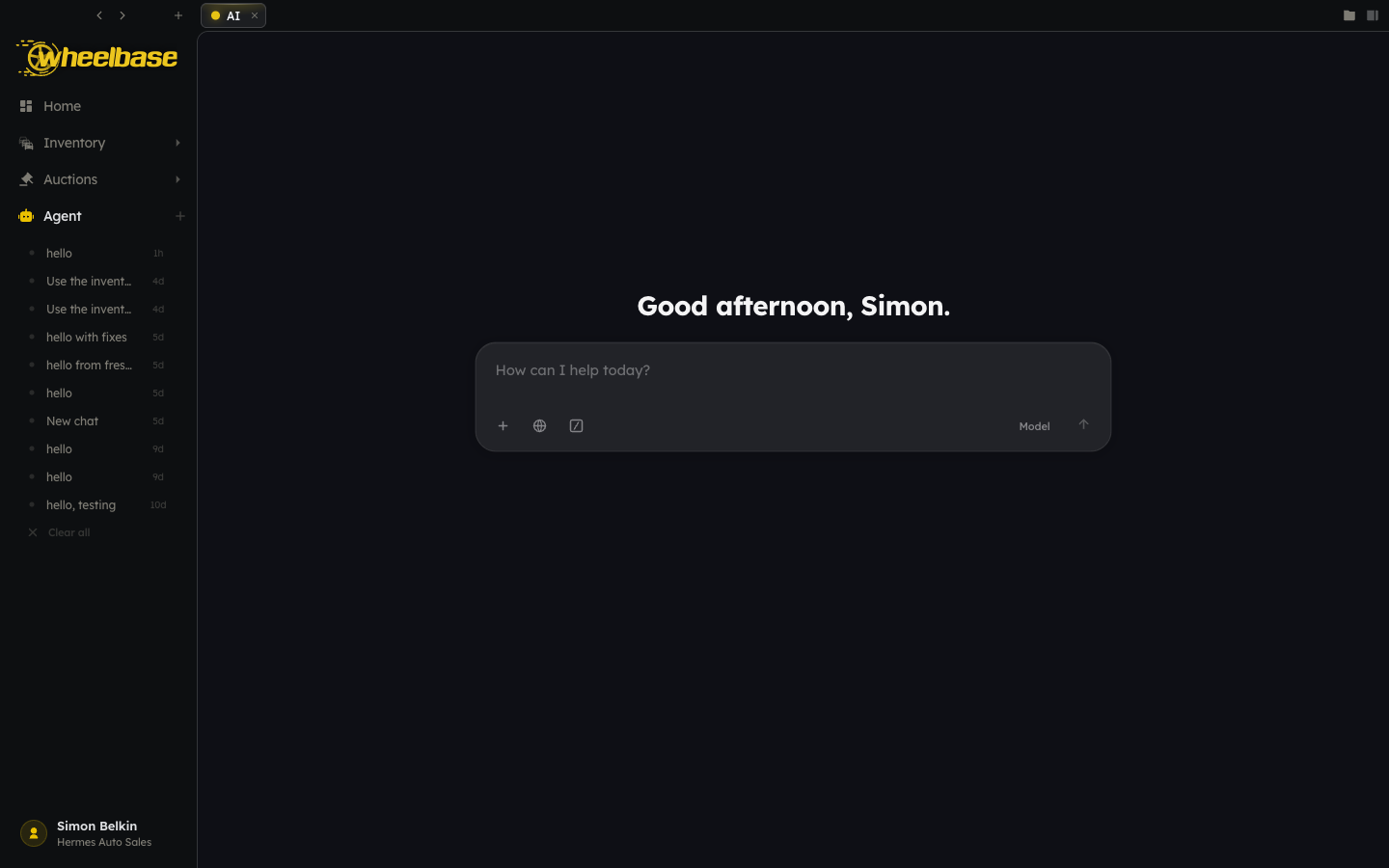
Wheelbase is the Cursor-versus-Copilot matchup applied to the dealership: an AI-native platform against established dealer software that bolted AI onto legacy products. Three things come together. It is AI-native, built around AI and an agent runtime from day one, so the AI runs repeatable operations rather than sitting in a chat box (see Wheelbase Agent, powered by OpenClaw). It is gamified, so keeping inventory, auction data, and customer records current feels engaging rather than a chore, with mechanics tuned for accuracy. And it is safe by design, with a human in the loop on anything consequential, so speed never costs you control.
Honest limits
A few caveats, plainly. Wheelbase is in closed beta, so the case studies above are an argument and a playbook, not a claim about our own traction. Incumbent platforms have real moats: entrenched integrations and switching costs that do not vanish because a better experience exists. And gamification only helps when it rewards the right behavior. We are betting on being purpose-built, fast, and disciplined about safety, not on legacy software simply disappearing.
The short version
There are two ways to put AI in a product, and only one rebuilds the workflow around the AI. Cursor showed that an AI-native challenger can win share fast against a much larger incumbent, while the innovator’s dilemma explains why those incumbents struggle to follow. Wheelbase brings that approach to dealerships, pairs it with a gamified interface that makes good data easier to capture, and keeps a human in the loop. See the full picture in AI dealership software.