Meet Wheelbase Agent: The AI Operator Built Into Your Dealership
Wheelbase Agent is an always-on AI agent (software that can take actions on its own, not just answer questions.) built into Wheelbase. It works your inventory and auction data the way a tireless operations manager would: grading run lists, building reconditioning tasks, watching competitor pricing, and running scheduled jobs without waiting for anyone to ask. It is powered by OpenClaw (the open-source agent engine Wheelbase is built on.) and it reflects a bigger shift. The same agent integration (connecting an AI agent directly to the tools and systems a business already runs.) approach, which large companies (NVIDIA among them) now treat as the next layer of enterprise software, is what Wheelbase Agent brings to the lot. This post explains what Wheelbase Agent does, why it is built on OpenClaw, and how it fits the broader move toward agents that run operations instead of just answering questions.
Key takeaways
- Wheelbase Agent is an always-on AI operator built into Wheelbase, not a chatbot bolted on the side.
- It is powered by OpenClaw, a self-hosted agent runtime that keeps persistent memory and connects to the tools you already use.
- It can integrate with any system and automate on any platform via browser automation, even where there is no API.
- It follows the agent-integration paradigm that NVIDIA and other large companies now adopt for continuous, monitor-and-act work.
- The payoff is operational leverage; the discipline is governance, oversight, and human review on anything consequential.
The shift big companies are making
For years, “AI at work” meant a person opening a chat window and asking a question. That is changing. The new pattern is agent integration: software that runs in the background, watches your systems, remembers context, and acts on a schedule rather than only when someone asks.
That loop is what makes an agent different from a chatbot. It repeats on its own, day after day.
flowchart LR
A[Watch your systems] --> B[Remember context]
B --> C[Act on a schedule]
C --> D[Report to you]
D --> A
NVIDIA lays this out in What OpenClaw Agents Mean for Every Organization, framing autonomous agents as a distinct wave of AI after predictive, generative, and reasoning systems. Its argument is about when to reach for one. According to NVIDIA, standard models suit “immediate, human-triggered queries,” while autonomous agents earn their keep on “tasks that require continuous background monitoring or periodic system checks without a manual start.” In plain terms: a regular AI is good at answering when you ask, while an agent is good at watching and acting when you are not there. The article points to agents monitoring trading systems and regulatory feeds in financial services, sweeping new scientific literature in drug discovery, and speeding up how fast IT problems get fixed. Different industries, same shape: an agent wired into the real systems, working between the moments a human checks in. Wheelbase Agent brings that shape to the dealership.
What Wheelbase Agent is
Wheelbase Agent is the AI that lives inside the Wheelbase desktop app, alongside your real inventory and auction data. It is not a sidebar chatbot. It is a teammate that:
- Grades every auction run list against your demand with IMX, so the right cars rise to the top before you bid.
- Auto-creates inspection and recon tasks the moment a unit lands, and routes them to the right people.
- Watches competitor pricing and aging inventory, then flags what needs attention before days-to-sale climbs.
- Runs scheduled jobs (daily auction alerts, end-of-day summaries) on its own, without anyone prompting it.
The part that makes it more than a dashboard: Wheelbase Agent can integrate with any system you already run, and it can operate any web tool through browser automation (the agent logging into and operating web tools like a person would.) This works even when a tool offers no direct software connection. The agent logs in and clicks through web tools like a member of staff. For the full product picture, see AI dealership software and auction management software.
A plain way to see the difference: an ordinary chatbot waits for you and forgets everything when the chat closes. Wheelbase Agent does not.
Ordinary chatbot
- Waits for you to ask a question
- Forgets everything when the chat closes
- Only answers, never acts
- Lives in one window, separate from your tools
Wheelbase Agent
- Runs on a schedule, no prompt needed
- Keeps memory across sessions
- Acts across your tools, not just talks
- Works inside your real inventory and auction data
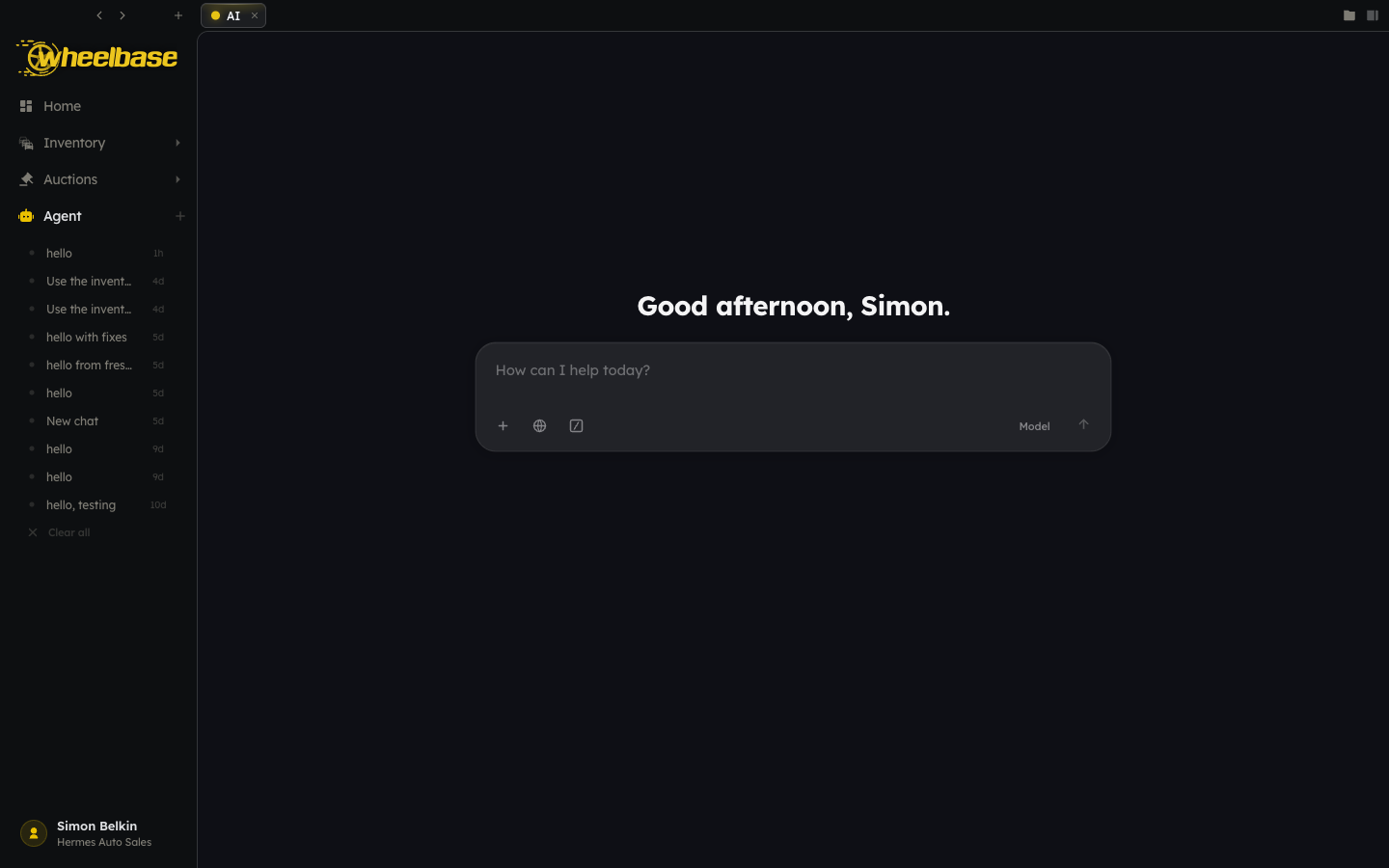
Powered by OpenClaw
Under the hood, Wheelbase Agent is built on OpenClaw, an open-source, self-hosted agent runtime. We chose it for three reasons that matter to a dealership:
- Persistent memory. OpenClaw keeps context across sessions instead of forgetting the moment a chat closes, so the agent builds up knowledge about your store, your market, and your preferences over time.
- Local-first and yours. It is designed to run on infrastructure you control, with memory you can see, rather than locked inside a vendor’s cloud.
- Tool use, not just talk. It connects the AI to real tools and actions, which is what turns a smart assistant into an operator that gets work done.
That last point is the whole game. NVIDIA ships its own hardened deployment of OpenClaw for enterprises (its reference implementation, NemoClaw), a sign that the same class of engine under Wheelbase Agent is being taken seriously at the largest scale. Wheelbase wraps that engine in a dealership-specific experience, so you get the benefits without having to set up agent infrastructure yourself.
OpenClaw is the engine; Wheelbase Agent is the car. You do not need to know anything about OpenClaw to use Wheelbase, the same way you do not think about the database behind your DMS. What matters is that the agent remembers, connects to your tools, and acts.
What it looks like on the lot
The agent-integration paradigm sounds abstract until it lands on a real operation. Here is the same idea applied to a used-car store:
- Before the sale. Wheelbase Agent imports the run list, grades it with IMX, and hands you a short “must buy” list instead of 800 rows to scroll.
- After the buy. It spins up the reconditioning checklist and routes tasks so nothing stalls between the lane and the line.
- Through the week. It watches comparable pricing, flags aging units, and drops an end-of-day summary so the team starts aligned.
- Across your tools. When a job touches a platform we do not formally integrate with, the agent works the browser the way your team does.
This is agent integration for a dealership: not a person asking an AI for help, but an AI running the repeatable operations so the people can focus on buying and selling cars.
Built to be trusted
An agent that can read your systems and act on its own has to be governed, not just switched on. A few principles we hold to and recommend:
- Scope access deliberately. Decide what the agent may see and touch before you connect anything sensitive.
- Keep a human in the loop for consequential actions (contacting customers, moving money, changing records). Prefer “draft and confirm” until a job earns trust.
- Treat output as a strong draft. Models still make confident mistakes, and an agent that stores a wrong fact will repeat it. Review the inputs that matter.
An always-on agent is an operational system, not a toy. Before you give it standing access and the ability to act, write down what it may read, what it may do without asking, and who reviews its actions.
The short version
The way work gets done with AI is shifting from “ask a question” to “run the operation,” and large companies are building around agents that monitor, remember, and act. Wheelbase Agent brings that paradigm to the dealership: an always-on operator, powered by OpenClaw, that grades auctions, builds recon, watches the market, and connects to the tools you already use. The upside is real leverage on the repeatable work. The discipline is governance and oversight. Start with well-scoped jobs, keep a human in the loop, and let the agent earn more responsibility as it proves itself.