What Is IMX? AI Auction Grading for Dealers, Explained
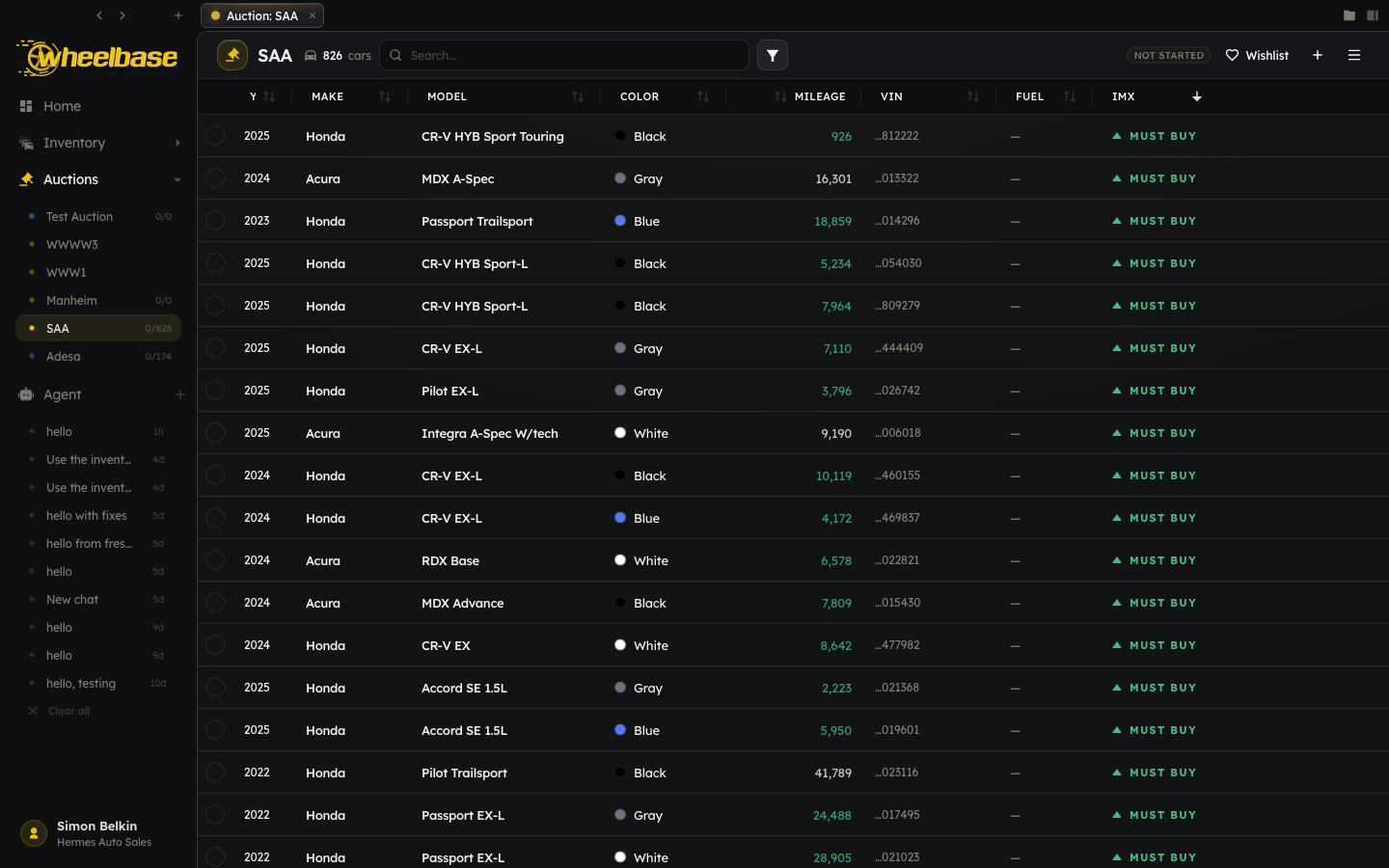
IMX (short for Inventory Match Index, Wheelbase’s AI grade for how well an auction car fits your specific lot.) is Wheelbase’s AI auction grading system. It scores every vehicle on an auction Run list (the published lineup of every vehicle scheduled to sell at an auction.) against the inventory your dealership actually needs to keep in stock, factoring in live market data and each car’s profit potential, then surfaces the strongest fits as high-grade “must buy” recommendations. In plain terms: IMX tells you which cars on the lane are right for your lot, before you bid.
This post explains what that grade means, how it differs from a traditional auction condition grade, and how dealers use it to buy smarter.
Key takeaways
- IMX (Inventory Match Index) is an AI grade for how well a run-list car fits your lot, not just its condition.
- It blends three inputs: your inventory demand, live market data, and the unit's profit potential.
- Top matches surface as high-grade 'must buy' picks, turning a huge run list into a short shopping list.
- It complements the auction's condition grade. One tells you the car's shape, the other tells you if it is right for you.
A condition grade tells you about the car. IMX tells you about the fit.
Auctions already grade cars. ADESA, Manheim, Southern Auto Auction, and the rest assign a condition grade (a score, usually 1 to 5, that summarizes the exterior, interior, and mechanical shape a car is in.). That grade is genuinely useful. It is also blind to your business. A pristine luxury coupe can be a great car and a terrible buy if your market sells work trucks and family SUVs, because that coupe will just sit on your lot.
IMX answers the question a condition grade cannot: is this the right car for this lot, at this price, right now? Think of it as a fit grade (a score for how well a car matches what your lot needs and can profit from, rather than what shape the car is in.) that sits on top of the condition grade, not a replacement for it. You still read the auction’s announcements (the disclosures about title, damage, and history) and condition reports. IMX just makes sure you are reading them on the cars worth your attention.
Auction condition grade
- Tells you what shape the car is in
- Looks at exterior, interior, and mechanical condition
- The same for every dealer who sees it
- Says nothing about whether the car sells on your lot
IMX fit grade
- Tells you whether the car is right for you
- Looks at your demand, the market, and the profit
- Tuned to your specific lot and region
- Points you to cars that actually retail for you
The three inputs behind the grade
IMX scores each run-list vehicle against three things:
- Your inventory demand. Wheelbase looks at your inventory-demand categories: the kinds of vehicles you need in stock to keep selling, meaning the segments, price bands, and body styles your market actually turns. A car that fills a real hole in your lot scores higher than one that duplicates aging inventory or chases a segment you do not retail.
- Live market data. Pricing and demand signals tell IMX what comparable cars are doing in the market right now, so the grade reflects today’s conditions rather than last quarter’s.
- Profit potential. The grade weighs the realistic gap between what you can buy the car for and what you can sell it for, so a strong match at a bad price does not get over-rewarded.
Roll those together and each vehicle gets a grade. The strongest combinations (right segment, healthy market, real margin) rise to the top as high-grade “must buy” picks.
flowchart LR
A[Run list] --> B{IMX grade}
B --> C[Your demand]
B --> D[Live market]
B --> E[Profit potential]
C --> F[Must-buy shortlist]
D --> F
E --> FHow dealers actually use it
The practical payoff is triage, meaning sorting the lane so you only study the cars worth studying. A big sale might have hundreds of cars on the run list. No buyer can price and evaluate all of them well, so most either spot-check a handful or drown in a spreadsheet. IMX flips that: the run list arrives already graded, so you start with the handful of cars that genuinely fit your lot and work down from there.
That changes the rhythm of buying. Instead of reacting in the lane, you walk in with a ranked shortlist, a clear sense of which cars are worth a condition report or a walkaround, and the confidence to pass on everything else. It is the homework, done before the sale. For the full discipline around using that shortlist, see our guide on how to buy cars at auction.
Use IMX to decide where to spend your attention, not to bid blind. A high IMX grade means a car deserves a closer look: pull the condition report, read the announcements, set your ceiling. The grade gets you to the right cars faster. Your buying discipline still closes the deal.
Where IMX gets its run lists
IMX needs a run list to grade, and Wheelbase pulls them in for you from any auction, in person or online. Where there is a direct connector the run list imports automatically, and everywhere else Wheelbase AI brings it in through browser automation. So whether your inventory comes from a national sale or a regional auction with no tidy data feed, IMX can still grade the lane against your lot.
That coverage matters because buyers rarely shop just one auction. Pulling every relevant run list into one graded view, regardless of platform, is what makes the shortlist genuinely complete instead of “the cars from the one auction with a clean API.”
How IMX fits the rest of your workflow
A grade is only worth something if it leads somewhere. The point of identifying a must-buy unit is to win it and turn it fast, so IMX sits at the front of a connected loop. When you act on a high-grade pick and the car becomes yours, Wheelbase can auto-create the inspection and recon tasks, monitor competitor pricing on comparable units, and run scheduled jobs so the unit keeps moving toward the line. The grade that started in the lane carries straight into reconditioning (see the used-car reconditioning process, step by step) and onto your frontline.
You can explore both halves of that loop directly: the auction management software that imports and grades your run lists, and the broader AI dealership software that carries those cars from purchase through recon and pricing.
Wheelbase is in closed beta. IMX grading is part of the auction toolset we are rolling out to dealers and auction buyers on the waitlist. Pricing, segments, and recommendations are tuned to each dealership’s own inventory and market.
The short version
A condition grade answers “what shape is this car in?” IMX answers “should I buy this car?” by scoring each run-list vehicle against your inventory demand, live market data, and profit potential, then putting the best fits at the top as high-grade must-buy picks. It does not replace your judgment or the auction’s condition grade. It points both at the cars that matter, so you spend your time and your floor plan on inventory that actually retails.