The Used-Car Reconditioning Process, Step by Step
Used-car reconditioning is the work of taking a car you just bought wholesale (at trade prices, usually from an auction or a trade-in, not from a retail buyer) and getting it frontline-ready: inspected, repaired, cleaned, photographed, and priced so it can go straight onto your lot and sell. A frontline-ready car is one that is finished and good to display on the sales line. Every day a unit spends in recon is a day it sits earning nothing while you still pay to carry it, so a tight recon process is one of the highest-leverage things a dealership can fix.
This is the step-by-step workflow the best stores run, plus where time leaks out and how to plug it.
Key takeaways
- Recon is a stopwatch, not a checklist. Your time-to-line directly drives days-to-sale and gross.
- Sequence matters: inspect first, decide go/no-go on big repairs, then move through mechanical, body, and detail.
- The handoffs between departments are where days disappear. Visibility beats hustle.
- Set a recon budget per unit at purchase and reconcile against it before the car goes live.
Why recon speed is a profit lever
Picture two stores that buy the identical car at the identical price. Store A turns it frontline-ready in three days. Store B takes twelve. Store B just paid nine extra days of floor plan interest (the loan interest a dealer pays on inventory while it sits unsold), nine extra days of depreciation in a soft market, and nine extra days before the unit could even start its retail clock. Multiply that across every car on the lot and the gap is the difference between a healthy store and a struggling one.
Recon does not just protect gross by fixing the car. It protects gross by speed. The faster a unit reaches the line, the fresher it is, the better it shows, and the less it costs you to carry. Treat time-to-line, the number of days from buying a car to having it ready on the line, as the number you manage. Shorten it and your days-to-sale (the days a unit takes to actually sell once it is listed) drops too.
Here is the full pipeline every car runs, start to finish:
flowchart LR
A[Intake] --> B[Inspection]
B --> C[Go or No-Go]
C --> D[Mechanical]
D --> E[Body and Paint]
E --> F[Detail]
F --> G[Photos]
G --> H[Frontline]
Step 1: Intake and check-in
Intake is the first stop: officially receiving the car and opening its recon file. The moment a unit lands on your property, it should be logged: VIN decoded (the VIN is the vehicle identification number, the unique code that identifies a specific car), photos of arrival condition, keys tagged, and a recon file opened. This sounds trivial. It is where stores lose the first day, because nobody officially “owns” the car yet and it parks in the back lot until someone trips over it.
Good intake answers three questions immediately: what did we buy, what did we expect to spend reconditioning it, and who is responsible for moving it forward.
Step 2: The recon inspection
Now the car goes to a tech for a structured inspection: mechanical systems, brakes and tires, fluids, electronics, warning lights, road test, and a careful look at the body and interior. The output is a line-item list of everything the car needs, split into two buckets:
- Must-do. Safety and the obvious retail standard items: brakes, tires, a cracked windshield, a check-engine light.
- Nice-to-have. Cosmetic touch-ups that may or may not pencil depending on the unit’s price band.
Run the full inspection before you touch a single repair. Spending two hours on a detail and a paint correction only to discover the car needs a transmission is how recon budgets blow up. Diagnose completely, decide, then execute.
Step 3: The go/no-go decision
With a real estimate in hand, compare it to the recon budget you set when you bought the car. If the number holds, approve and proceed. If a surprise (frame issue, expensive driveline repair) blows the budget, you have a decision: invest and reprice, or wholesale the unit out and recover what you can. Making that call on day one instead of day ten is the entire ballgame. Cars become money pits when nobody pulls the trigger on the no-go.
This is also the moment to tie recon back to how you bought the car. If you set a clean all-in number in the lane (see our guide on how to buy cars at auction), this reconciliation is fast because your recon estimate was already part of the deal.
Step 4: Mechanical repairs
Approved work goes to the shop. Mechanical comes first because it is the most likely to uncover additional needed work and because everything downstream (alignment, road-test confirmation) depends on it. Knock out the must-do list, verify with a second road test, and clear every warning light. A unit that goes to the line with a lit dash is a unit that comes back.
Step 5: Body and paint
Next, address cosmetic damage that affects how the car shows and retails: dents, scuffs, curb-rashed wheels, paint chips, bumper scrapes. Paintless dent repair, touch-up, and wheel refinishing are usually fast, high-ROI moves on retail units. The goal is not a showroom restoration; it is removing the visual objections that make a buyer hesitate or negotiate.
Step 6: Detail
Detail is where a car stops looking like a wholesale buy and starts looking like your car. A full interior and exterior detail (and, depending on the unit, an engine-bay cleanup) is one of the cheapest gross-protectors in the business. Buyers form an impression in the first ten seconds, and a clean, sharp car supports your asking price far better than any line in the description.
Step 7: Photos and merchandising
The car is now frontline-ready, and it earns nothing until it is online. Shoot a complete, consistent set of photos in good light, write the listing, and publish across your channels. Speed here matters as much as anywhere: a finished car sitting unphotographed for three days is just a slower version of every delay above.
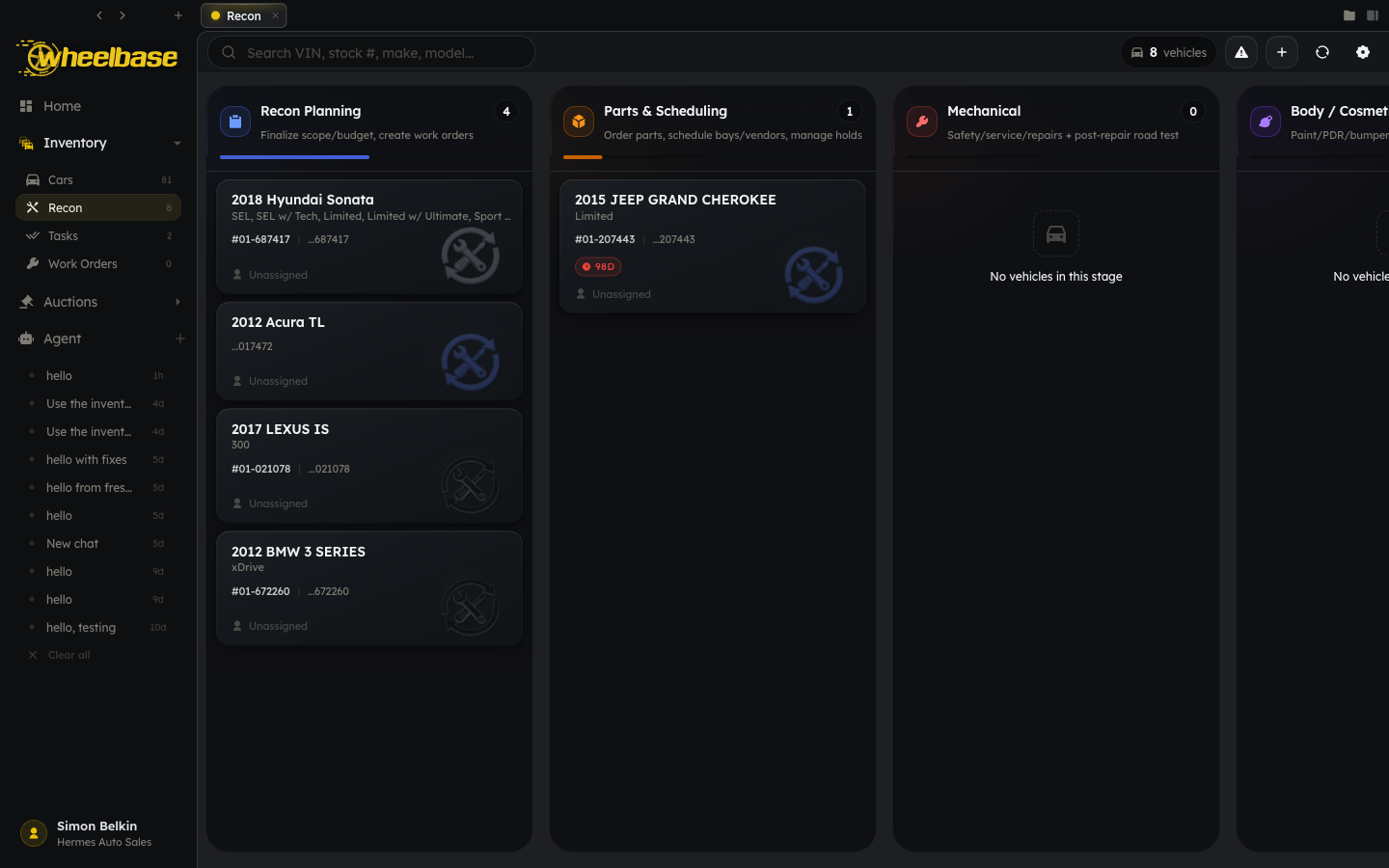
The biggest time leak in recon is almost never the work itself. It is the dead time between steps, when a car waits for someone to notice it is ready for the next station. If you cannot see where every unit is in the pipeline at a glance, you are losing days you will never get back.
Where the days actually go
Add up the hands-on labor in a typical recon and it might total a few hours. Yet many stores average a week or more to the line. The missing days live in the handoffs: the car waiting for inspection, waiting for an approval, waiting for a parts order, waiting to be moved to detail, waiting to be photographed.
Recon without visibility
- Cars idle between steps until someone notices them
- No single owner for moving a unit forward
- Approvals and parts orders stall in a blind spot
- Days leak away in the handoffs
Recon with visibility
- Every unit's status is tracked at a glance
- The next person is notified the instant a step finishes
- Stalls surface immediately instead of days later
- Dead time between steps collapses
Fixing that is a visibility problem, not a hustle problem. When every unit’s status is tracked and the next responsible person is notified the instant a step finishes, the dead time collapses. Wheelbase auto-creates the inspection and recon tasks the moment a unit is purchased, tracks each car through the pipeline, and runs scheduled jobs so nothing stalls in a blind spot. Our AI dealership software gives the whole team one live view of every car between the buy and the line, while the auction management software feeds clean, graded inventory into the top of that pipeline so recon starts on the right cars.
A recon process you can actually run
Boil it down to a repeatable loop:
- Intake the unit the day it arrives. Open a file, set a budget.
- Inspect fully before touching anything. Produce a line-item estimate.
- Decide go/no-go against the budget on day one.
- Mechanical, then body and paint, then detail, in that order.
- Photograph and publish the moment it is frontline-ready.
- Reconcile actual recon spend against the budget before the car goes live.
Run that loop with real visibility into every handoff and your days-to-sale drops, your gross holds, and your lot stays full of fresh, sharp cars instead of stale ones stuck in the back.