How to Buy Cars at Auction: A Dealer's Guide
Buying cars at auction is how most used-car dealers stock the lot. You bid on Wholesale (the dealer-to-dealer market where cars trade below retail, before they hit a sales lot.) inventory at a physical or online sale, win the vehicles that fit your demand and your numbers, and recondition them into frontline-ready retail units. Done well, the lane is your cheapest, fastest source of profitable inventory. Done sloppily, it is the fastest way to fill your lot with units that sit and bleed.
This guide walks through the whole cycle the way a working buyer thinks about it: prep before the sale, discipline in the lane, and what happens after the hammer drops.
Key takeaways
- The run list is where you win or lose. Do your homework before you ever walk the lane.
- Set a hard ceiling on every car (bid plus fees plus recon plus target gross) and do not chase past it.
- Inspect or arrange a condition report on anything you are serious about. Announcements and grades are not the same as a walkaround.
- Buy to your demand, not to your gut. Stock what your market actually retails fast.
Start with the run list, not the lane
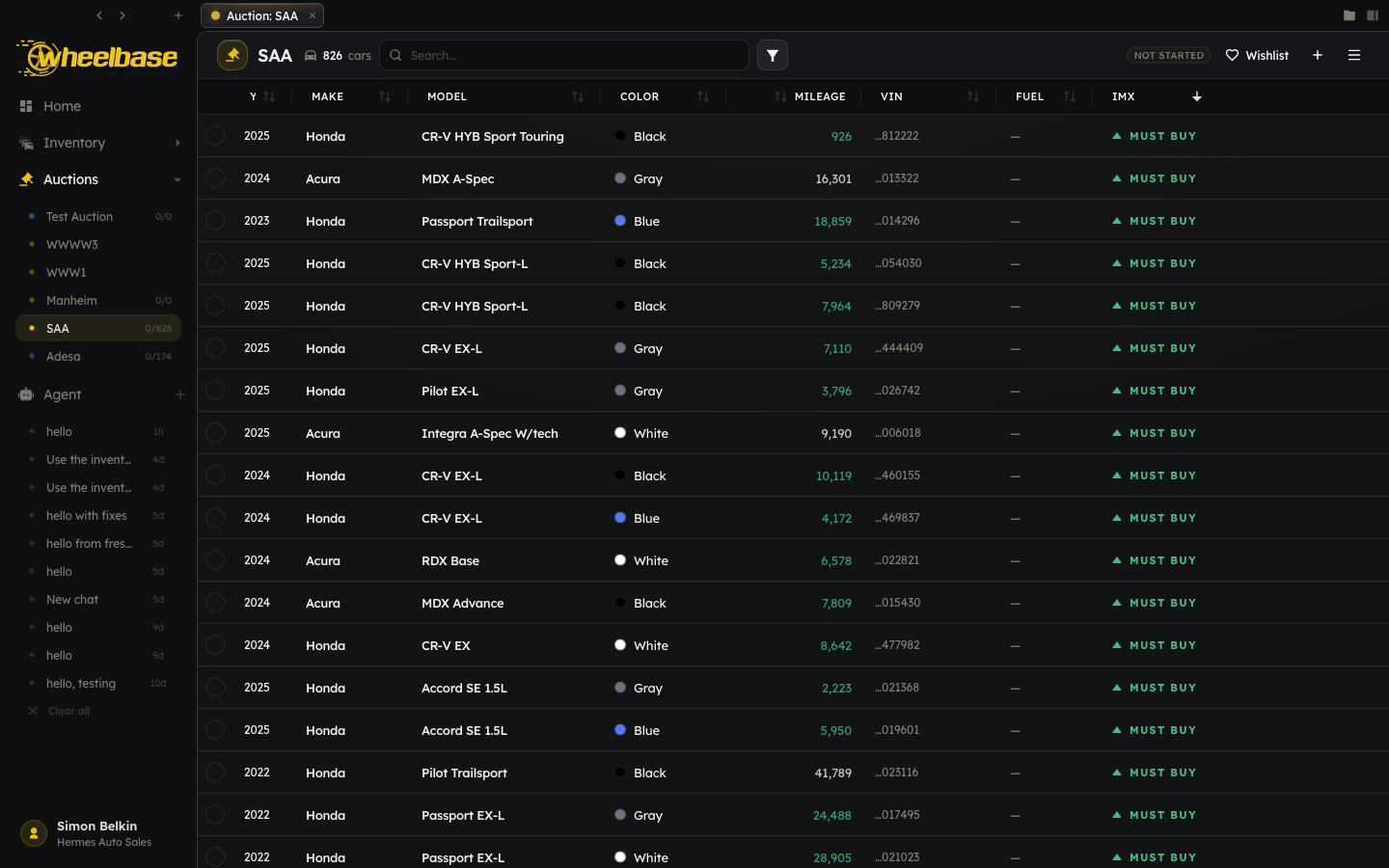
The Run list (the published lineup of every vehicle scheduled to sell at an auction, usually released days before the sale.) is the lineup of vehicles scheduled to cross the block. Most auctions publish it a few days ahead of the sale, whether it is a big national sale or a small regional one. That lead time is your edge. The buyers who win consistently have already decided which cars they want before they ever stand in The lane (the row at the auction where cars roll across the block one at a time and dealers bid in real time.).
Work the list against three questions:
- Do I need it? Does this unit fit a hole in your inventory, a segment your market retails quickly?
- Can I price it? Pull comps. Know the retail ceiling and the wholesale floor before you bid.
- What will it cost me all-in? Bid price is only part of the deal. Add the buy fee, transport, and your Recon (reconditioning: the cleanup and repair work, from detailing to tires and brakes, that gets a car ready to sell.) estimate. That total is your all-in ceiling: the most you will pay including every fee and the recon to come.
This is exactly the kind of grind that software should carry for you. Wheelbase imports run lists from any auction you buy from, in person or online (through browser automation when there is no direct connector), then grades every vehicle against what your lot actually needs. Our auction management software turns a 400-car run list into a short, ranked shopping list so you are not scrolling a spreadsheet at midnight.
Set your numbers before the hammer
The single most common way dealers lose money in the lane is emotional bidding. You decided a car was worth $14,200 all-in, the bidding hits $14,500, and you tell yourself “it is only three hundred more.” Three hundred dollars times every chased car is your quarter.
Build a real ceiling for each target:
- Retail target. What you realistically sell it for, not the optimistic number.
- Target gross. What you need to make on the unit. Say a $2,500 gross on a mainstream sedan.
- Recon estimate. Tires, brakes, a windshield, detail, any reconditioning the car obviously needs.
- Fees and transport. Buy fee, arbitration coverage if you take it, and the cost to get it home.
Work backward. Start with your retail target, then subtract the gross you want, the recon it needs, and the fees. What is left is your maximum bid. Write it down. When the auctioneer blows past it, you are out. No exceptions.
- 1Prep
Pull the run list early and flag the cars that fit your demand.
- 2Set a ceiling
Price each target and lock in an all-in maximum bid.
- 3Read announcements
Check the title, damage history, and condition grade.
- 4Bid in the lane
Bid clean and stop the moment you hit your number.
- 5Hand off to recon
Mark it bought and start the recon and listing work.
The lane is engineered to make you bid fast and feel behind. That pressure is the product. Your written ceiling is the only thing standing between a disciplined buy and a unit that sits 90 days. Trust the number you set when you were calm.
Read the announcements and the grade
Every car that crosses the block comes with Announcements (the facts the auction calls out as a car runs, like frame damage or a bad title, often shown as colored lights above the lane (green means sellable, red means as-is, yellow means caution).): frame damage, prior structural repair, a salvage or branded title (a title flagged because the car was once written off or rebuilt), mileage that does not add up, or an “as-is” tag with no arbitration. These announcements are binding, so the seller is on the hook for what they say and silent on what they leave out. Listen, watch the lights, and read the block sheet.
Most auctions also assign a condition grade, typically on a 1 to 5 scale, summing up exterior, interior, and mechanical condition in one number. A grade is a useful shorthand, but it is a starting point, not a guarantee. A 3.5 with a clean announcement can still need a grand in tires and a bumper. Whenever you can, do a walkaround yourself or pull a detailed condition report with photos before you commit.
This is also where AI grading earns its keep. If you want the deeper version of how machine grading fits on top of the auction grade, read our explainer on what IMX is and how AI auction grading works. The short version: a traditional grade tells you about the car’s condition; an inventory-demand grade tells you whether this car is right for your lot.
Work the lane (or the online sale)
When the car you want comes up, you already know your ceiling, so your job in the lane is simple: bid with intent and stop on time.
A few habits that separate pros from tourists:
- Get there early. Walk your target cars before they run. A two-minute walkaround catches the things photos hide: paint mismatch, panel gaps, tire wear, warning lights at start-up.
- Bid clean. Quick, confident bids signal you are serious and can discourage a back-and-forth war. Hesitation invites it.
- Use arbitration when it fits. If the sale offers a post-sale inspection or arbitration window, factor it in. It is cheap insurance against an undisclosed problem on a borderline unit.
- Online sales count too. A growing share of wholesale moves through simulcast (the live sale streamed online so you can bid from your desk) and pure online lanes. The discipline is identical, you just lose the walkaround, so lean harder on condition reports and announcements.
On the block in person
- Walk the car yourself before it runs
- Read the lane and the auctioneer's pace
- Spot paint mismatch and panel gaps live
- Hear the engine at start-up
Buying online
- Same written ceiling, same hard stop
- Lean harder on the condition report and photos
- Treat announcements as your eyes on the car
- Use arbitration as your safety net
Buy to your days-to-sale, not to your ego. A car that retails in 21 days at a $1,800 gross beats a “home run” unit that sits 75 days tying up floor plan and lot space. Velocity is profit.
After the hammer: recon and the lot
Winning the bid is the start, not the finish. If you bought the car on floor plan (the line of credit dealers use to finance inventory), the interest clock started the moment you owned it. Every day between the purchase and frontline-ready is cost you cannot get back, and a day the car is not earning.
Have a plan for the handoff before you buy: transport booked, recon slotted, photos and listing ready to go the moment it is frontline-ready. The dealers with the lowest days-to-sale are not buying magically better cars. They are moving cars through recon and onto the line faster than everyone else. If you want the full breakdown, see our used-car reconditioning process, step by step.
Wheelbase ties this together so the buy does not die in a spreadsheet. The moment you mark a unit purchased, our AI dealership software can auto-create the inspection and recon tasks, monitor competitor pricing on comparable units, and run scheduled jobs so nothing slips between the lane and the line.
The buyer’s pre-sale checklist
Before every sale, run this:
- Pull the run list early and flag every unit that fits your demand.
- Price each target: retail ceiling, target gross, recon estimate, fees.
- Write a hard maximum bid for each car. Sign your name to it mentally.
- Read announcements and grades; arrange a condition report or walkaround on serious targets.
- Confirm transport and recon capacity for what you expect to win.
- In the lane, bid clean and stop on time. Every time.
Master that loop and the auction stops being a gamble. It becomes the most reliable, highest-margin inventory channel you have.