How AI Helps Technicians Diagnose, Inspect, and Fix Cars Faster
AI in the repair bay means using machine learning and AI-powered search to help a technician understand a fault, find the right fix, and grade a car’s condition faster than digging through manuals by hand. In a used-car dealership, that work happens during reconditioning: a tech inspects an incoming car, diagnoses what is wrong, and gets it frontline-ready (finished and good to put on the sales line). This article explains three places AI is already useful for that job, the payoff, and the limits you should not ignore.
Key takeaways
- AI search lets a tech describe a symptom in plain words and get the right manual section, bulletin, or proven fix with citations, instead of keyword-hunting through PDFs.
- AI-assisted diagnostics turn a raw trouble code into plain meaning, a ranked list of likely causes, and the next test to run, which cuts guess-and-swap parts waste.
- AI vision speeds and standardizes condition grading at intake, producing consistent, reviewable inspection data.
- AI can be confidently wrong, so a qualified technician owns the final call. Most accuracy and savings numbers from vendors are self-reported.
The problem AI is trying to solve in recon
Reconditioning runs on a stopwatch. Every day a car sits in the shop is a day it earns nothing while you still pay to carry it. The slowest part is rarely the wrench time. It is the time a tech spends figuring out what is actually wrong, then finding the documented fix, then verifying it before the car goes back to the line. For a step-by-step view of where those days leak out, see our guide on the used-car reconditioning process.
That figuring-out problem is getting harder at the worst possible moment. The TechForce Foundation’s 2024 Supply and Demand Report projects nearly one million new-entry transportation technicians needed across the auto, diesel, collision, and aviation sectors over five years (2024 to 2028), and notes that replacement need outpaces workforce growth by more than four to one in the auto, diesel, and collision trades (TechForce Foundation, 2024). Fewer experienced techs, more complex cars. That gap is exactly what AI tools are pitched to help fill.
1. AI search over manuals, bulletins, and trouble-code databases
The first job is finding the right information fast. A repair tech has to navigate OEM service manuals, wiring diagrams, recalls, and the database of stored fault codes. The old way is keyword search through PDFs: you have to already know the right term to find the right page.
AI search works differently. It is built on RAG (RAG, or retrieval-augmented generation, which pairs a language model with a step that first pulls relevant passages from a trusted knowledge base, then answers from those passages with citations) rather than from the model’s memory alone. The practical effect: a tech can describe a symptom in plain language, like “rough idle and a misfire on cold start,” and get the matching manual section, a relevant TSB (TSB, or technical service bulletin, which is an OEM notice documenting a known issue and its recommended fix for specific models), or a proven real-world fix, even without knowing the exact factory terminology. Because the answer is grounded in source documents and shows where it came from, the tech can check it.
The source material for this already exists. Established repair-information platforms aggregate OEM factory data, including diagnostic codes and bulletins, and some layer verified shop fixes on top of the official data. A 2025 peer-reviewed paper by Yildirim and Samli built a RAG assistant retrieving over vehicle manuals, maintenance logs, and troubleshooting guides, and the authors report it gave “more precise and context-aware responses than traditional generative models” when evaluated against 487 real customer-service call transcripts (Yildirim and Samli, 2025). That is a research-setting result, not a shop benchmark, but it points the direction.
Manual lookup
- Keyword search through PDFs and binders
- You must know the exact term to find the page
- Senior techs carry the know-how in their heads
- Guess-and-swap when the manual is unclear
AI search and diagnosis
- Describe the symptom in plain language
- Get the matching procedure, bulletin, or fix
- Answers grounded in sources with citations
- Ranked likely causes and the next test to run
2. AI-assisted diagnostics: from a raw code to the next test
The second job is interpreting what the car is telling you. Modern vehicles report faults through OBD-II (OBD-II, the standardized on-board diagnostics port and protocol on essentially every US light vehicle since 1996, which a scan tool plugs into to read data and codes). When a scan tool pulls a DTC (DTC, or diagnostic trouble code, like P0301, which names a symptom or affected circuit rather than the root cause), the code is a starting point, not an answer. A P0301 says “cylinder 1 misfire.” It does not tell you whether the culprit is a coil, a plug, an injector, or a wiring fault.
This is where less-experienced techs lose time and money: they read the code, swap the most likely part, and hope. When the guess is wrong, parts get wasted and the car can end up a comeback (comeback, a repair that fails so the car comes back to the shop). AI-assisted diagnostics aim to break that loop. The recurring pattern is to move from the raw code to a plain-language explanation, then to probable causes ranked by likelihood, then to the specific checks that separate one cause from another before any part is ordered. Consumer tools already show the shape of this, returning a code’s plain meaning, common causes, drivability status, urgency, and repair guidance from a single scan.
flowchart LR
A[Symptom or trouble code] --> B[AI search over manuals and bulletins]
B --> C[Ranked likely causes]
C --> D[Next test to run]
D --> E[Verified fix]
Research reports are encouraging but should be read as research, not shop results. One knowledge-graph and LLM study reports about 91% diagnostic accuracy with structured multi-round prompting (Electronics, 2025). These are controlled-setting figures, not field-validated comeback reductions. AI can help a tech reason from a code to the right test faster, and verifying the repair before handoff is the mechanism that should reduce comebacks, but independent shop-floor proof of that reduction is still thin.
3. AI vision for inspection and condition grading
The third job is inspection. At intake, a tech walks an incoming car and grades its condition: dents, scratches, rust, tire wear. Done by eye, this is subjective and varies from one inspector to the next. AI vision changes the inputs. A phone or fixed camera captures photos or a 360-degree video, and a model auto-detects damage, outlines it, and tags severity, turning a subjective walkaround into a structured, reviewable report. Vendors in this space report detecting damage across many vehicle parts and damage types, including small scratches a person might miss, and increasingly fold in tire-tread and engine-data checks toward a single combined condition report. Those accuracy and speed figures are vendor self-reported, so treat them as illustrative.
The durable value here is consistency, not magic. Standardized criteria mean every vehicle is graded the same way regardless of who inspects it, which reduces inspector-to-inspector variance. For a dealership, that consistent data feeds a more accurate appraisal and a defensible recon punch list from day one.
The payoff: faster, cheaper, and a hand for newer techs
Put the three together and the recon math improves in three ways. Diagnosis gets faster because a natural-language query replaces manual hunting through manuals. Inspection gets faster and more consistent because grading is processed in seconds against fixed criteria. And labor cost should fall when fewer wrong parts get swapped and fewer cars come back. Combine seconds-fast inspection grading with faster diagnosis and you compress days-to-frontline, the time a car sits in recon before it can be listed.
The most important payoff is people. AI assistants that explain a cause and prescribe the next test effectively encode some of a senior tech’s experience, which helps a less-experienced tech work more accurately during a documented labor shortage. That is the honest framing: augmenting technicians, not replacing them.
Be skeptical of the headline numbers. The strongest accuracy figures come from research settings, and the strongest time and cost savings come from vendor blogs and single-shop anecdotes, not independent studies. More importantly, AI can be confidently wrong. A hallucinated procedure could point a tech at the wrong part or an unsafe step, so grounding answers in verified OEM and bulletin data with citations is necessary, not optional. Keep a qualified technician in the loop to own the final call.
The honest limits
Three limits deserve plain statement. First, hallucination: a language model can produce a confident, plausible, wrong answer, which is why RAG grounding and citations matter and why a human must verify. Second, liability and oversight: research on automotive LLMs stresses guardrails and human review in safety-critical contexts, and harm from bad guidance is an open legal question, so the tech, not the model, owns the decision (arXiv, 2025). Third, data quality: answers are only as good as the underlying documents, so coverage gaps on newer models, EVs, or rare faults degrade output.
None of this means waiting. It means choosing tools that are grounded in trusted sources, show their work, and keep a tech in the loop by design. Treat AI as a fast, well-read assistant that surfaces the right information and a ranked starting point, while the qualified person confirms and decides.
How Wheelbase fits
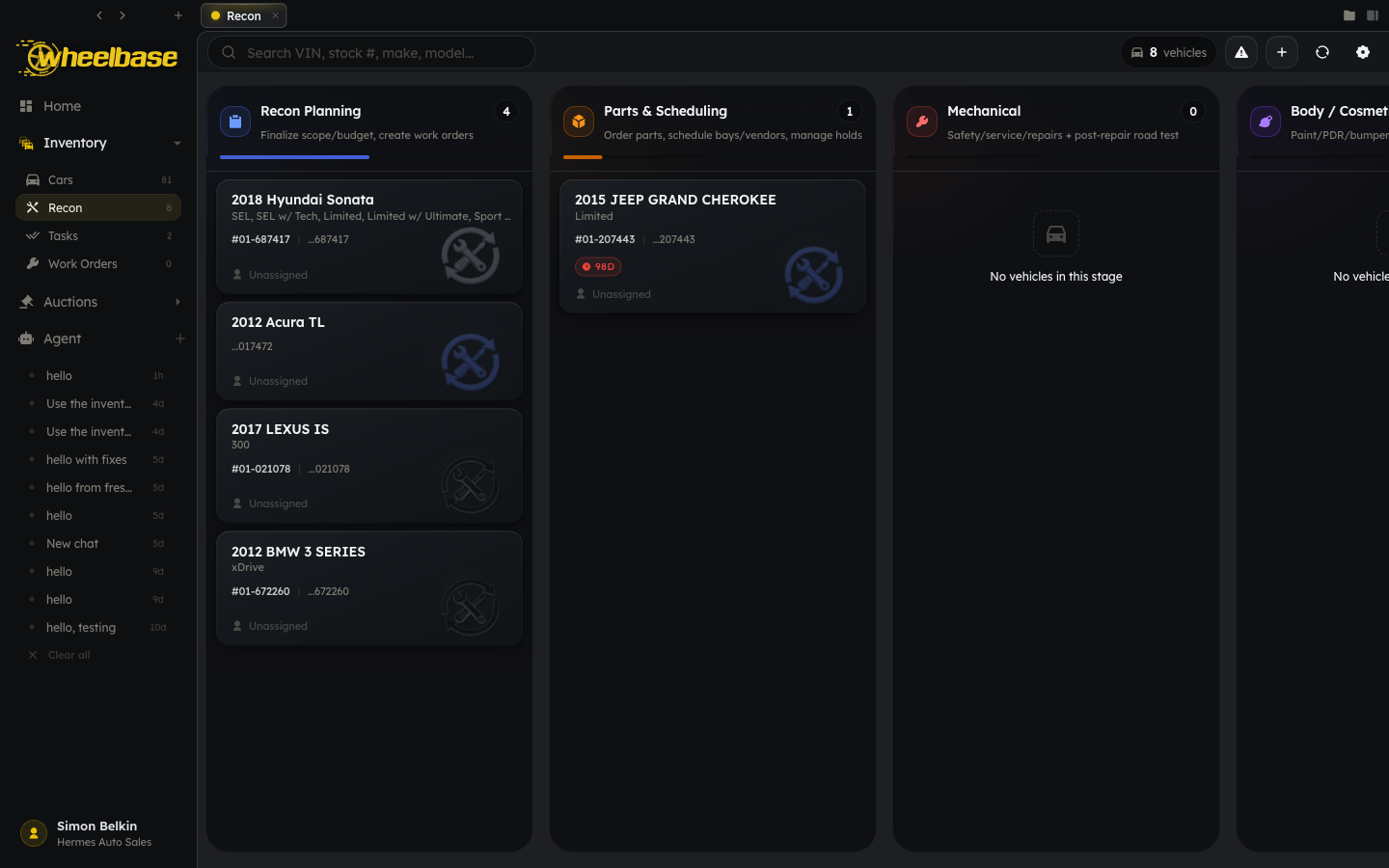
Wheelbase is building an AI-native reconditioning workflow for used-car dealerships, and this is the direction it is built for: put AI search over repair knowledge right where techs already work, use AI-guided inspection to capture accurate and consistent condition data at intake, and help newer techs perform closer to experienced ones, so days-to-frontline and comebacks shrink. Wheelbase is in closed beta, so we make no unproven claims about specific diagnostic features. The principle we hold to is human in the loop and safe by design: grounded, cited answers with a qualified tech making the call. See how the pieces connect in our reconditioning software and the broader AI dealership software.